

In the world of high-traffic applications, "concurrency" is often the monster under the bed. Imagine millions of users hitting a "Like" button simultaneously. In a traditional database, this is a recipe for a race condition—where two simultaneous requests read the same value (say, 100), both add one, and both write back 101. You’ve just lost a like.
Enter Redis Atomic Increments.
This guide dives deep into how the INCR command and its cousins provide a lightning-fast, thread-safe solution for the internet's busiest counters.
What is an Atomic Increment?
At its core, "atomic" means an operation is indivisible. When you call INCR in Redis, the server guarantees that the "read-modify-write" cycle happens as a single step. No other command can "sneak in" between the read and the update.
The Core Commands
INCR: Increments the integer value of a key by one.INCRBY: Increments by a specific integer (e.g.,INCRBY post:123:likes 5).HINCRBY: The same, but for a field inside a Redis Hash.ZINCRBY: Increments the score of a member in a Sorted Set (perfect for leaderboards).
Real-World Example 1: The Instagram "Like" Counter
When a celebrity like Cristiano Ronaldo posts a photo, the "likes" don't trickly in—they flood in.
The Challenge
A traditional SQL update looks like this:
SELECT likes FROM posts WHERE id = 1;SET likes = likes + 1;UPDATE posts SET likes = ...
Under heavy load, two servers might execute Step 1 at the same time, seeing "5000". Both calculate "5001" and update the DB. One like is gone.
The Redis Solution
Using Redis, you store the like count in a simple key: post:99:likes.
When a user clicks like, your backend simply sends:
INCR post:99:likes
Redis handles the math internally. Even if 10,000 requests hit at the same microsecond, Redis processes them sequentially (thanks to its single-threaded event loop), ensuring the final count is exactly +10,000.
Pro Tip: To keep your main database (PostgreSQL/MySQL) in sync, you can "flush" these counts from Redis to SQL in batches every few minutes rather than on every single click.
Real-World Example 2: The "Flash Sale" Inventory Tracker
Ecommerce giants use Redis to manage "Limited Stock" items during sales where items sell out in seconds.
The Challenge
If you have 100 iPhones and 10,000 people clicking "Buy," you cannot afford to oversell. A standard database lock might be too slow, causing the site to lag right when you need it to be fastest.
The Redis Solution
You use DECR (the opposite of increment).
Store stock:
SET product:iphone:stock 100When a user tries to buy:
DECR product:iphone:stockIf the returned value is $\ge 0$, the purchase is valid.
If it's $< 0$, the item is sold out; you immediately show "Out of Stock" to the user.
Real-World Example 3: API Rate Limiting
Ever seen a "Too Many Requests" error? That’s likely Redis at work.
The Challenge
You want to allow a user only 100 API calls per minute. Checking a database for every request would double your latency.
The Redis Solution
You can create a key that combines the User ID and the current minute: user:123:min:45.
INCR user:123:min:45EXPIRE user:123:min:45 60(Set the key to delete itself after a minute).If the result of
INCRis $> 100$, block the request.
This is the "Fixed Window" rate-limiting pattern, and it’s incredibly efficient because it uses O(1) operations.
Pros and Cons of Redis Increments
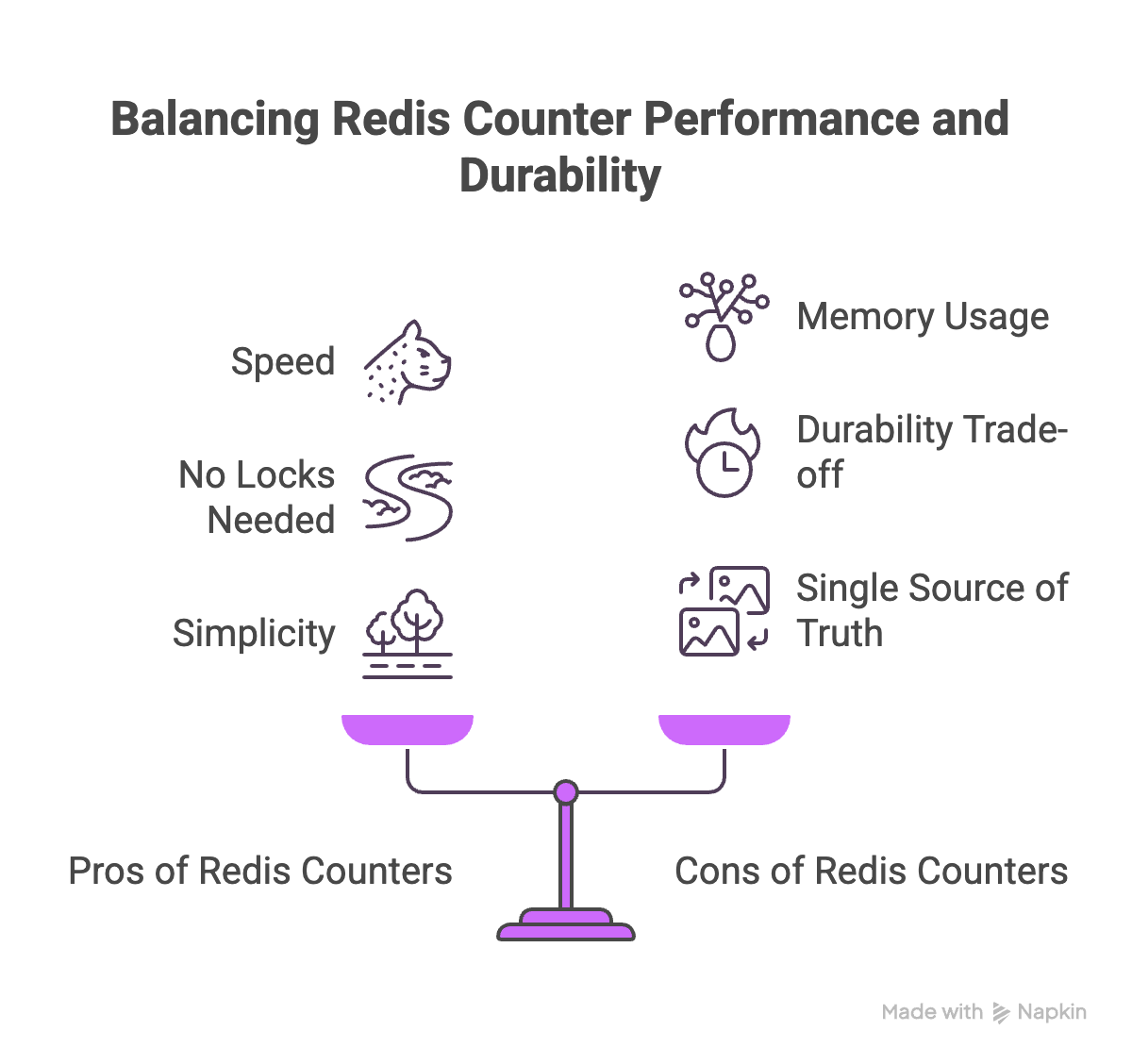
The Pros
Speed: Since Redis is in-memory,
INCRoperations take less than a millisecond.No Locks Needed: Unlike SQL "SELECT FOR UPDATE," Redis doesn't lock rows, preventing bottlenecks.
Concurrency Safe: Built-in protection against race conditions.
Simplicity: One command replaces complex transaction logic.
The Cons
Memory Usage: Storing millions of small counters can add up. (Use Hashes to optimize memory).
Durability Trade-off: If Redis crashes and hasn't saved to disk recently (AOF/RDB), you might lose the last few seconds of "likes."
Single Source of Truth: Usually, Redis is a cache. You still need a strategy to persist these numbers to a permanent database.
Interactive Quiz: Test Your Redis Knowledge
Scenario: You are building a "Views" counter for a video.
Which command would you use to add 1 view?
SET views +1INCR video:viewsADD video:views 1
✅ Answer: B
Scenario: You want to reward a user with 50 points.
Which command is best?
INCRBY user:points 50INCR user:points(called 50 times)
✅ Answer: A
Summary Table: Which Increment Command to Use?
| Use Case | Data Structure | Command |
|---|---|---|
| Simple Likes/Views | String | INCR |
| Scoring/Leaderboards | Sorted Set | ZINCRBY |
| Multiple counters per user | Hash | HINCRBY |
| Inventory Countdown | String | DECR |
Conclusion
Redis atomic increments are the unsung heroes of the modern web. They allow us to scale "social" features to millions of users without crashing our primary databases. Whether you're counting likes, protecting your API, or managing a flash sale, INCR is your best friend.